How McDermott + Bull cut candidate-profile time by 90%
What a partner-led search looks like when the write-up is not the bottleneck anymore.
reduction in candidate-profile time, every search
Retained executive search has settled into a clear answer to the loudest AI question in recruiting. It is not whether AI replaces the recruiter. It is which parts of the week the partner gets to reclaim. Bullhorn’s 2026 industry data puts firms with the strongest year-over-year revenue growth — those above 25% — at four times more likely than the rest of the market to be running AI inside their ATS.
For most retained firms, the loudest part of the week is the candidate write-up. Radancy’s 2025 reporting put admin work at 45% of the recruiter workweek; Bullhorn’s GRID survey points to over three hours a week absorbed by the kind of formatting, copy-paste, and reformatting AI can take off the desk when it is there. The recruiter who should be on the phone with a candidate is, in fact, retyping the candidate’s last role into a write-up template.
McDermott + Bull came to us with that problem framed precisely: the candidate data already lived inside the ATS, so the data layer was solved. What was not solved was the partner-authored submittal — the 2-to-3 page argument the firm sends to the client, the artefact the firm is actually paid for. It had to land in McDermott + Bull’s voice, against their standards, every time. And it had to do so without flattening the partner’s judgement into algorithmic scoring.
What the work looks like, one mandate at a time
Below is what the work looks like inside MyCandidate.ai on a single mandate. The screenshots are from the live product — what the recruiter and the partner actually see when an engagement moves through the platform.
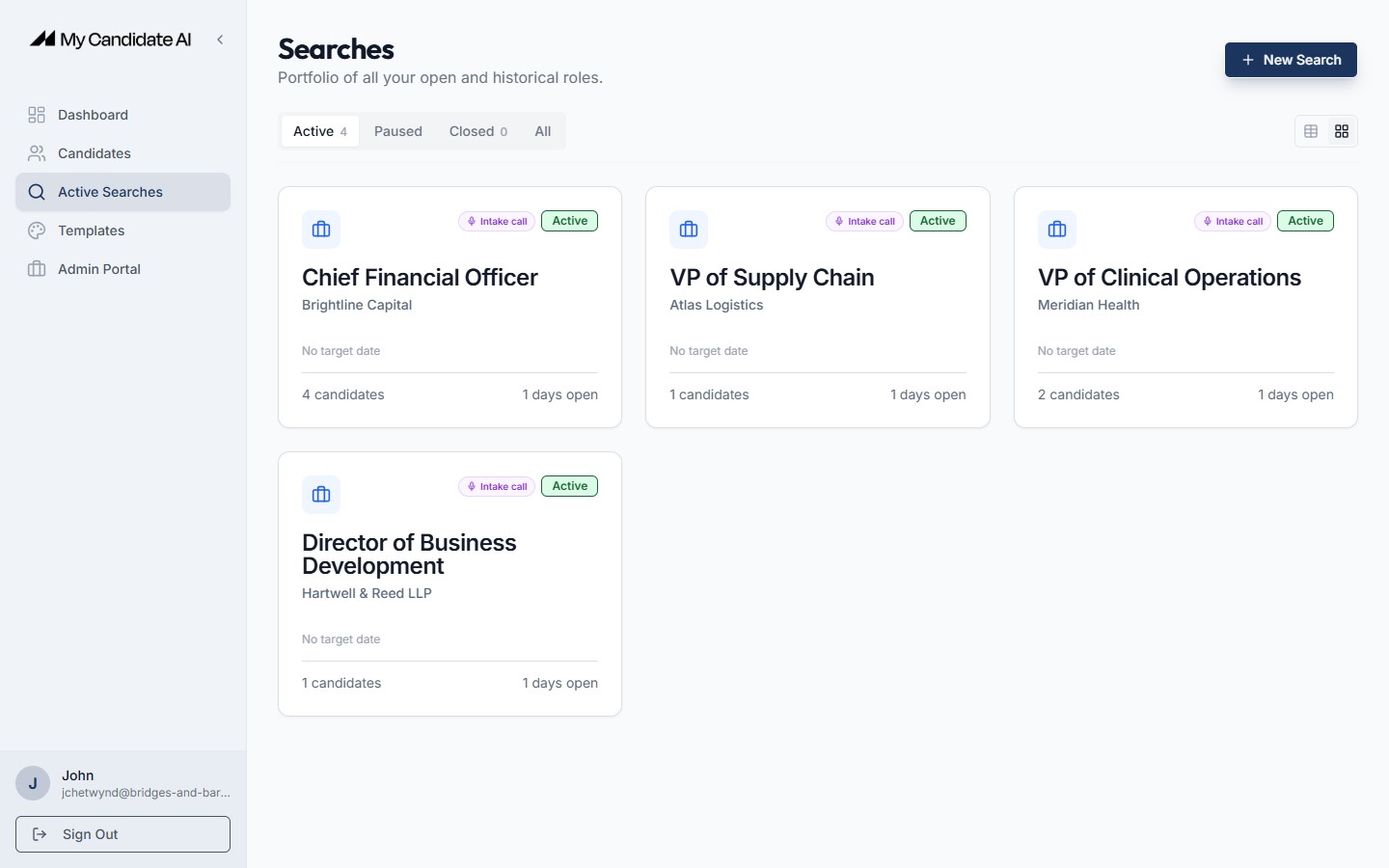
A new mandate is loaded as an active search
The brief lands in MyCandidate.ai as a search. The Role Model — the partner’s view of what the right candidate looks like for this specific mandate — is built from the brief and the firm’s house criteria. It is the structure the rest of the work runs against.
The AI tool reduced time spent on candidate profiles by 90% while increasing our recruiting team’s CRM utilization and driving higher data integrity.
less time on candidate profiles
fewer write-up errors
CRM data completeness as a second-order effect
The 90% number is the headline, and it is the one Rod leads with. The second number — 98% fewer errors — sits next to it for a related reason: when the writing is automated and the data validation is structured, the things that used to slip through (wrong title, wrong tenure, wrong date, wrong format) stop slipping through. The recruiter’s eye is reserved for judgement, not proofreading.
The compound effect is the part Rod emphasises on a phone call: not just faster individual write-ups, but better engagement with candidates, fuller CRM data, fewer mistakes carrying through to the client. When the tool reads from the CRM and writes back to the CRM, the recruiter’s workflow rewards keeping the system complete. It gets cleaner because the daily work makes it clean.
What this could look like for your firm
Most firms start with a Pilot — one of your live searches, end-to-end through the platform. Bring whatever past write-ups you can share and we calibrate the voice in the first session. By the end of the search, you know whether the work makes the case for a firm rollout.
If you want to see what one of your live searches looks like through MyCandidate.ai, the Pilot is about five minutes to set up and a real search to evaluate against. We will work in your firm’s voice, against your standards, on your own candidates.
Last reviewed May 27, 2026. McDermott + Bull approved this case study before publication.